
How to read a blazon: a beginner’s guide to the language of heraldry
Every coat of arms has a written description, called its blazon. It reads like a foreign language at first: “Gules, three lions passant guardant in pale Or.” But that sentence is the royal arms of England, and once you know a few rules you can read it, and draw it, without ever having seen the picture.
That’s the point of a blazon. It isn’t a caption. It’s the definition of the arms. Artists in different centuries draw a lion in their own style, but as long as they follow the blazon, they’re drawing the same arms. That makes the blazon the most useful thing you can have when commissioning a ring.
Why heraldry has its own language
Heraldry took shape in the 12th and 13th centuries, when Norman French was the language of the English court and of anyone who mattered. Heralds recorded arms in that language, and many of its words have survived ever since. Red is gules, gold is Or, silver is argent and blue is azure. (Our guide to the colours of heraldry covers them all.)
The odd vocabulary serves a purpose. Each term means one thing exactly, so a herald in London, Edinburgh or Dublin will read a blazon in the same way.
Dexter and sinister: the shield’s point of view
The first rule surprises everyone. A shield is described from the point of view of the man holding it, not the person looking at it.
So the dexter side, the bearer’s right, is on your left as you look at the shield. The sinister side, the bearer’s left, is on your right. The top of the shield is the chief and the bottom is the base. Once you picture a knight standing behind his shield, the rest falls into place.
The order of a blazon
A blazon always follows the same order:
- The field, the background colour of the shield, comes first.
- The main charge comes next, with its colour, such as a chevron, a cross or a lion.
- Any smaller charges follow, along with where they sit.
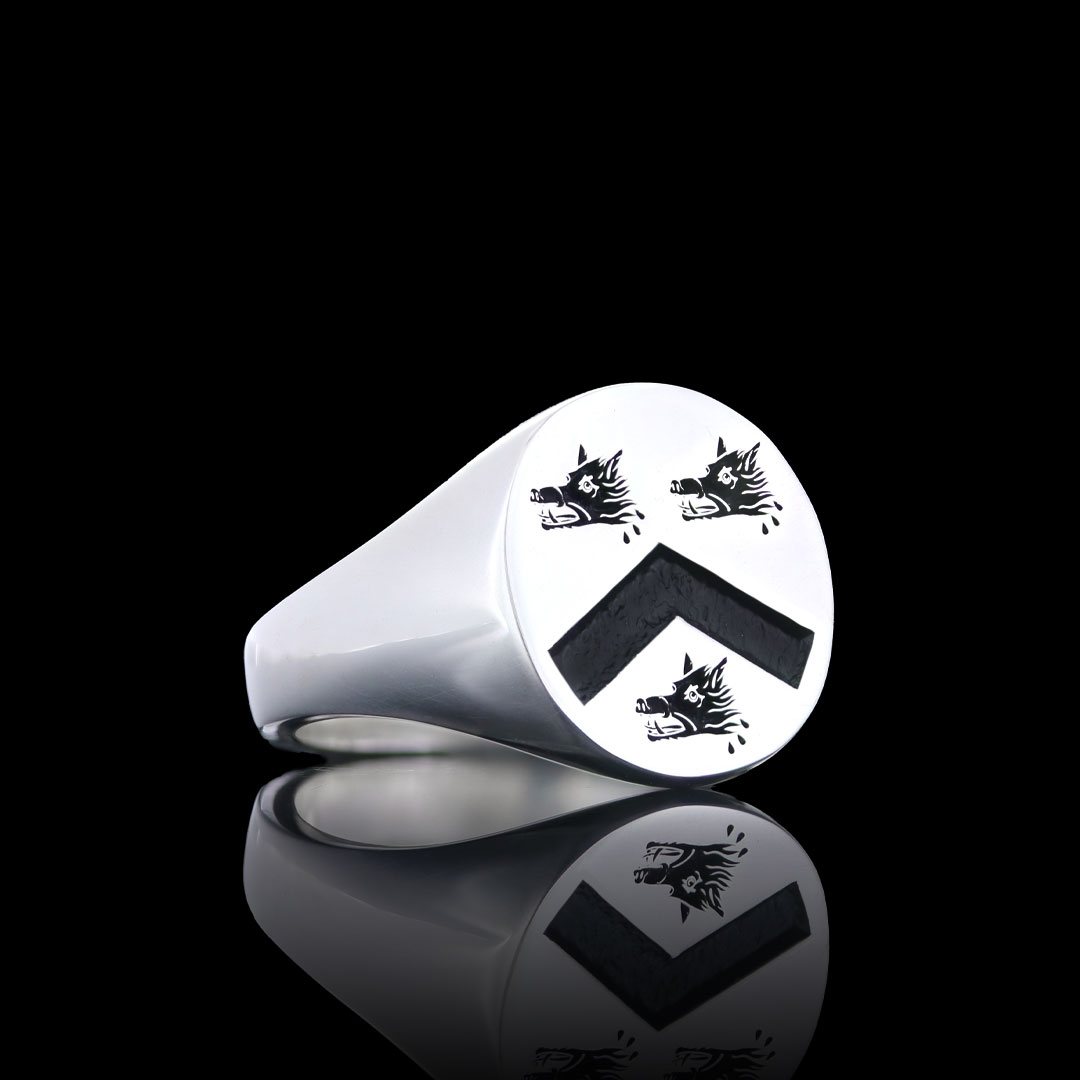
So “Azure, a chevron between three mullets Or” means a blue shield with a gold chevron and three gold five-pointed stars, two above the chevron and one below. Only one colour is named at the end because it applies to everything before it.
The ordinaries: heraldry’s simplest shapes
Before the lions and eagles, there were bold geometric shapes, easy to recognise from a distance. They’re called the ordinaries, and they’re among the oldest designs in heraldry.
- The chief
- A broad band across the top of the shield.
- The fess
- A broad horizontal band across the middle.
- The pale
- A broad vertical band down the middle.
- The bend
- A diagonal band from the dexter chief to the sinister base, so from the top left to the bottom right as you look at it.
- The chevron
- An upturned V, like the rafters of a roof.
- The cross
- The familiar upright cross, which comes in dozens of heraldic forms.
- The saltire
- A diagonal cross, the cross of St Andrew on the flag of Scotland.
Dividing the shield
Sometimes the shield itself is divided rather than having a shape placed on it. “Per pale” splits it down the middle into two halves, and “per fess” splits it across. “Quarterly” divides it into four, which is how families combined the arms of the houses they married into. A quartered shield can carry several family lines at once, a family tree in a single design.
The lines dividing a shield needn’t be straight. They can be wavy, indented like teeth, or embattled like the top of a castle wall, and each has its own name.
Lions rampant and passant
Animals have their own vocabulary too, because their pose, or attitude, is part of the arms.
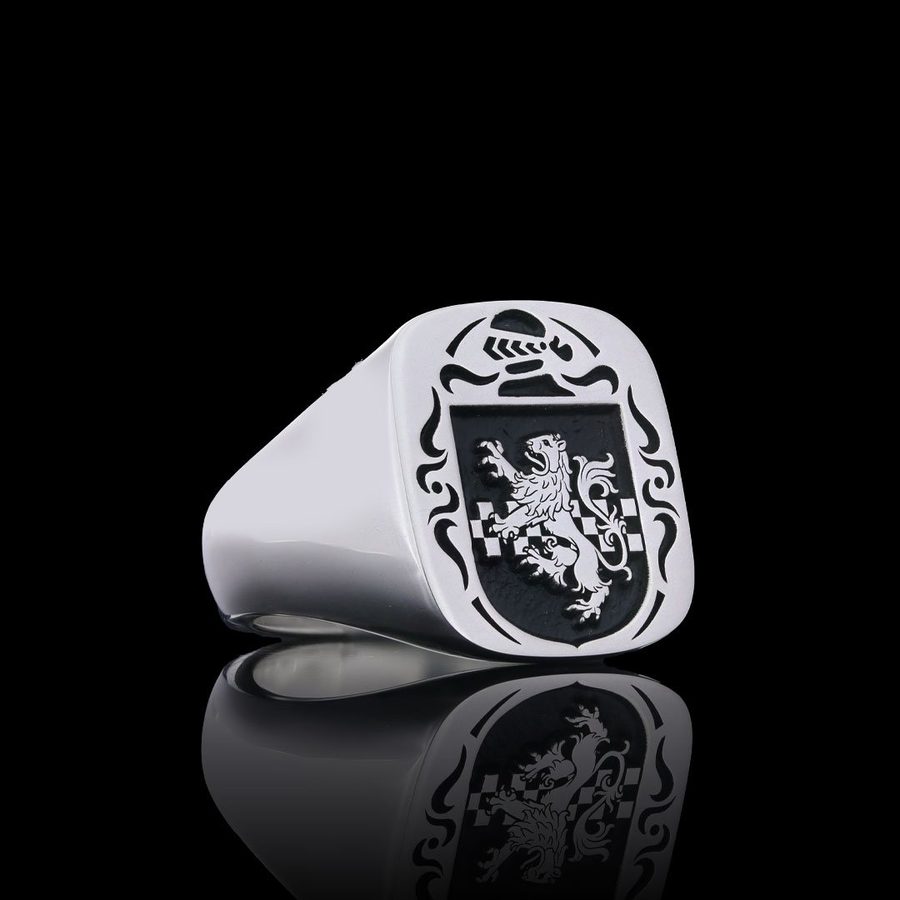
A lion rampant stands on one hind leg with its forepaws raised, ready to strike. It’s the lion of the royal arms of Scotland. A lion passant walks with one forepaw raised. Add “guardant” and it turns its face towards you, as the three lions of England do. A lion statant stands with all four feet on the ground, and a lion sejant sits.
Put it together and the royal arms of England make sense: a red shield (gules), three lions walking with their faces turned to the viewer (passant guardant), one above the other (in pale), all in gold (Or).
Why the blazon matters for your ring
If you know the blazon of your coat of arms, send it to us with any picture you have. Old drawings vary, and a faded print can make a lion look like a dog or turn a mullet into a flower. The blazon settles it. Our designers work from it to make sure every charge on your ring is correct and in its proper place.
At Clanmalier, every ring is made to order. Send us your blazon, a picture of your arms or simply your family name, and we’ll prepare a design for your approval before we handcraft the ring.