
Irish coats of arms: a guide to Gaelic and Norman heraldry
Irish heraldry didn’t begin with a king deciding the country needed shields and mottos. It grew from two very different worlds meeting. One was an ancient Gaelic clan society with its own strong sense of lineage and symbol. The other arrived with the Normans in 1169, bringing the continental habit of arms granted and recorded by heralds.
The result is unusual in Europe: a heraldic tradition that made room for two different ideas of what a family symbol means. Knowing which one your name belongs to tells you a good deal about how your family moved through Irish history.
Two traditions: Gaelic and Norman
Gaelic Ireland was organised around kin. A chief was not simply a landowner with a title but the head of an extended family group, or sept, chosen from among the ruling kin rather than automatically being the eldest son. This custom was called tanistry. Symbols mattered on banners, seals and the standards carried into battle, but they grew from clan identity rather than from any formal system of grants.
The Norman and later Anglo-Irish families brought that formal system with them. Their arms were granted by heralds, recorded, and passed down through documented descent, much as they were in England. For centuries the two traditions ran side by side, and today’s Irish heraldry still carries both.
Some Norman families became so much a part of Irish life that they were said to have grown “more Irish than the Irish themselves”. The Fitzgeralds, Earls of Kildare and Desmond, and the Burkes of Connacht are the best-known examples.
Reading Irish arms
Look at enough Irish coats of arms and the same images keep returning. Irish heraldry drew on a smaller, closely shared set of symbols rooted in Gaelic legend, the provinces and the land itself.
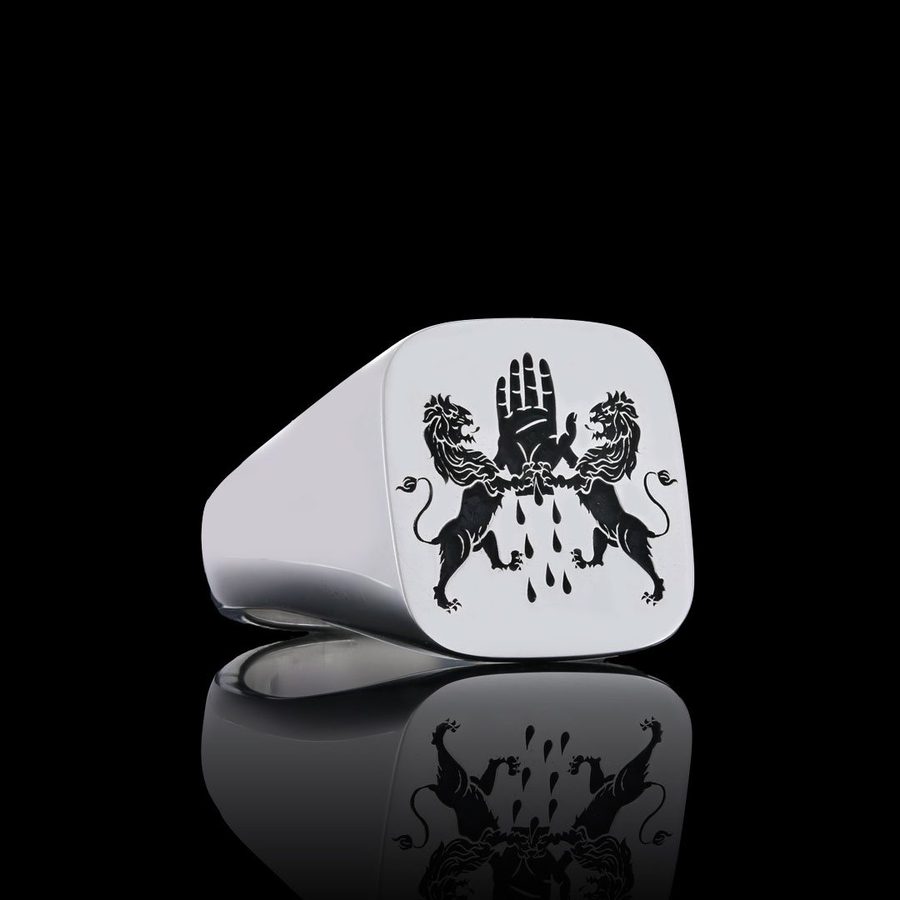
The most famous is the red hand, an open hand in red, palm outwards. Legend tells of a chieftain racing a rival by boat to claim Ulster, who cut off his own hand and threw it ashore to touch the land first. True or not, the story explains its meaning: a claim to land, whatever the cost. It belongs to the O’Neills and appears in the arms of the province of Ulster.
Animals in Irish arms tend to be wild rather than tame. The wolf, which survived in Ireland until the 18th century, stands for courage and watchfulness. The stag, common in the arms of woodland septs, stands for dignity and speed. Towers and castles usually mark a family’s role defending a stretch of territory, and green appears often for obvious reasons.
The great Irish families and their arms
Some Irish names carry so much history that their arms read like a timeline of the country.
The O’Neills of Ulster bore the red hand, the mark of one of the most powerful Gaelic dynasties in Irish history. The O’Briens, descended from Brian Boru, High King of Ireland, bear three lions, an emblem of royal authority few Gaelic families could claim. The Fitzgeralds bear a red saltire, a diagonal cross, on a silver field. The Burkes, or de Burghs, bear a red cross on gold. The MacCarthys, who held Gaelic power in Munster longer than almost any other family, bear a red stag.
These arms branched as families did. As a clan spread across different territories, each branch usually kept the core of the family’s arms and changed a detail: a border, a colour or an added charge. That’s why a surname alone can’t tell you which arms are yours. Two people called Burke may descend from different branches, and only one may carry a documented right to particular arms.
Researching an Irish name
Ireland has a heraldic authority of its own. The Office of the Chief Herald of Ireland, based at the National Library of Ireland in Dublin, continues the work of the Ulster King of Arms, whose office was founded in 1552. Its records hold centuries of grants, confirmations and pedigrees, and the Chief Herald can tell you whether arms already belong to your family or guide you through a new grant.
Start with your own family, though, not a famous namesake. Build the line back one generation at a time using baptism, marriage and death records. The civil records on irishgenealogy.ie and the 1901 and 1911 census returns held by the National Archives of Ireland are the usual places to begin.
Be prepared for gaps. Many older records were lost when the Public Record Office in Dublin was destroyed in 1922, so some lines can’t be traced as far back as families hope. Spellings shifted too, between Gaelic and English forms and from one clerk to the next, so search every version of your name.
Wearing Irish arms
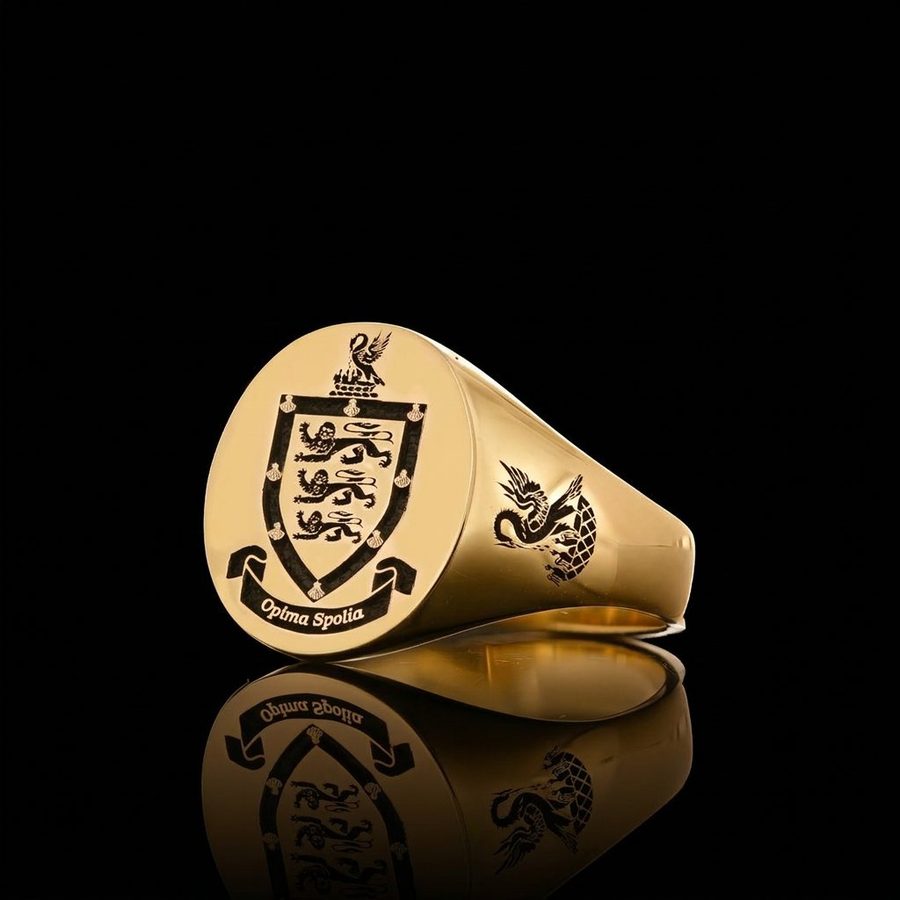
An Irish coat of arms might carry the formal stamp of Norman heraldry or the older, clan-rooted authority of a Gaelic sept. Both deserve to be engraved with care, keeping the character of the tradition they came from.
If your research leads to arms that belong to your line, a signet ring is a fine way to carry them. If it leads to the arms of your name more broadly, many families wear them as a link to that history, understood as heritage rather than a personal inheritance.
At Clanmalier, every ring is made to order. Tell us your surname and where in Ireland your family came from, if you know. We’ll look into the heraldry recorded for your name, prepare a design for your approval and handcraft the ring.